A car stalled on a railroad crossing is the one breakdown where staying with your vehicle is the wrong move. Everywhere else the usual advice holds: a flat on Highway 198, a no-start in a Lacey Boulevard parking lot, a dead battery on a farm road past Armona, and the safe play is to stay put, stay visible and wait. On the rails it inverts. The car is worth less than the thirty seconds you would spend saving it, and the thing coming toward it cannot swerve and cannot stop the way traffic stops. Here is what to do and in what order, and what California expects of you at a crossing.
What should you do first if your car stalls on the tracks?
Get everyone out of the vehicle and away from the tracks immediately, even if there is no train in sight. Operation Lifesaver, the national rail safety education non-profit, puts it without qualification: if your vehicle ever stalls on the tracks, get out and get away from the tracks, even if you do not see a train. That comes before anything else you might be tempted to do.
What it rules out matters as much as what it asks. Do not try the ignition one more time. Do not reach across the seat for a bag, a laptop or an empty child seat. Do not stand at the door working out whether the car might roll clear. Each is seconds spent inside a space you have no business occupying.
Get passengers out on the side facing away from road traffic where the layout allows, then keep everyone moving. Clear of the rails does not mean standing on the ballast six feet away: a train is wider than the track it runs on, and wreckage from a struck vehicle travels. Put real distance behind you, and something solid between you and the crossing if there is any.
What is the blue-and-white sign at the crossing for?
That sign is the Emergency Notification System sign, and it is the fastest route to the people who can stop a train. The Federal Railroad Administration describes it as the marker that gives the public critical emergency contact information at every highway-rail grade crossing, and it carries the two things a dispatcher needs: the railroad's emergency telephone number, and the U.S. Department of Transportation National Crossing Inventory Number, which the FRA says identifies the exact location of the crossing to the railroads.
That inventory number is the point. Nobody can act on "the crossing near the packing shed on 12th Avenue," but a crossing ID resolves to one specific set of rails. Read it straight off the sign, say what has happened, and say whether anyone is still near the tracks.
California's driver handbook tells drivers to expect it: many crossings, it notes, carry a blue and white sign telling you what to do if there is an emergency on or near the tracks or if your vehicle has stalled. Call from where you are standing, well clear, not from beside the car. No sign in reach? Dial 911 and lead with the words "vehicle on a railroad crossing."
Why does a crossing breakdown behave differently from every other one?
Because you are stopped inside a right of way where nothing can move around you. On Highway 43 a disabled car is an obstacle other drivers steer past. On a crossing it has no alternative path in front of it, and what is approaching runs on fixed rails and outweighs anything else on the road. Hazard lights, a warning triangle, a raised hood: that vocabulary is built for traffic that can change lanes.
It also reverses the usual order of calls. In an ordinary breakdown you get a tow moving first and sort out the rest afterwards. Here the first call slows or stops traffic on the rails, and the tow is a much later problem. Emergency towing can wait ten minutes. The railroad call cannot wait at all.
The last difference is the hardest to obey: once you are clear, stay clear. People go back, for the dog, for the registration, for a phone in the cupholder, or because minutes have passed and standing in a field starts to feel foolish. Nothing about the crossing changed in those minutes. Treat the rails as a line you do not recross until someone with authority over that track says it is finished.
What do California's crossing rules actually require?
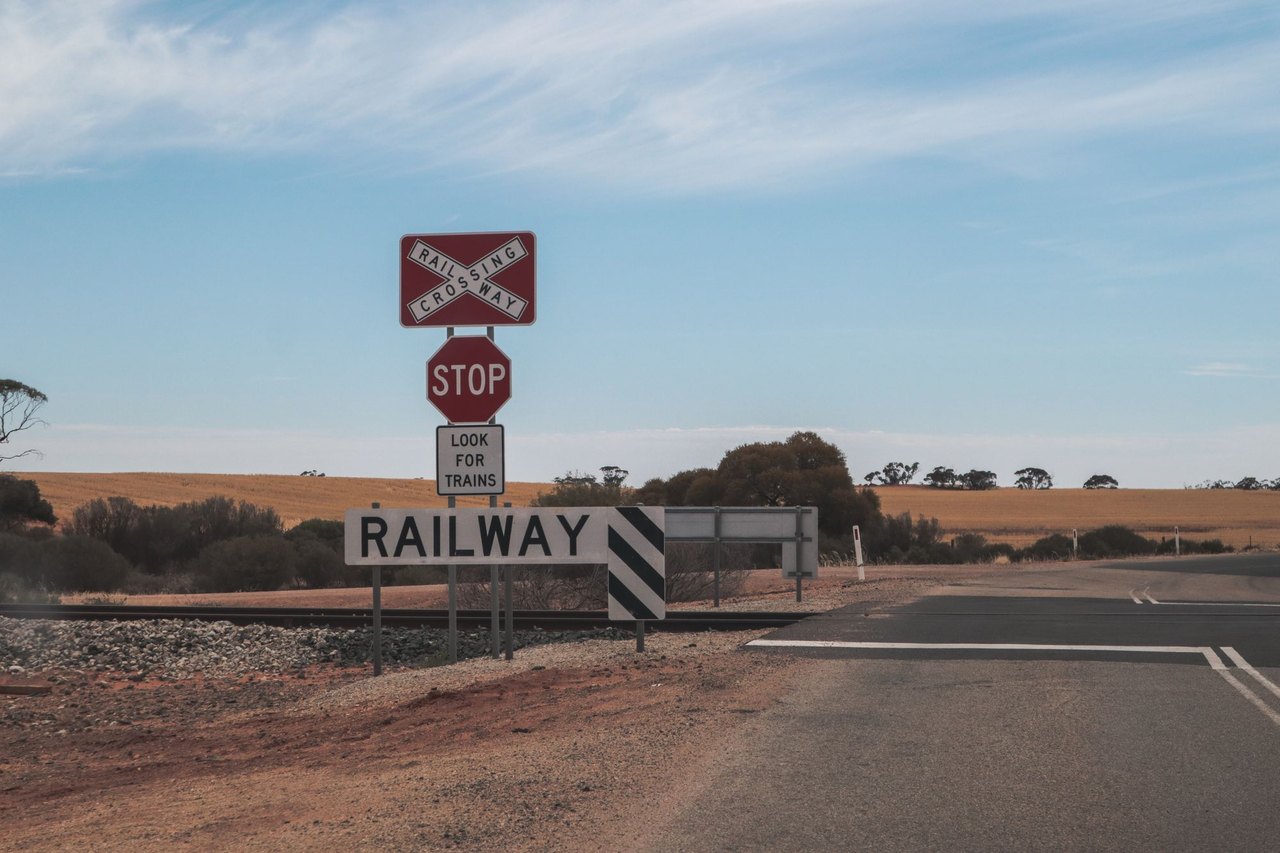
Most of them exist to stop a vehicle ever being stationary on the rails. The state driver handbook sets a 15 mph limit within 100 feet of a railroad crossing where you cannot see the tracks for 400 feet in both directions, and tells drivers to stop at least 15 feet from the nearest track when the crossing devices or a flagger warn of a train.
Two instructions are worth reading twice. Flashing red lights mean stop and wait, and the handbook is blunt that you do not proceed until they stop flashing, even if the gate rises: a raised gate is not a clearance. Nor do you go under a lowering gate or around a lowered one.
The clause that prevents this whole scenario is the plainest. Never stop on the tracks, and do not begin crossing without room to get completely clear. Traffic stacked on the far side is a reason to hold behind the rails, not to creep forward and hope.
One more rule carries weight in Kings County: buses, school buses and vehicles marked with a hazardous materials placard must stop before crossing. On school routes through Armona and Stratford, and on farm roads at harvest, those are ordinary traffic. When the vehicle ahead brakes with no train in sight, that is usually why.
What puts a vehicle on a crossing in the first place?
Usually it is not a decision made at the crossing, but one made ten seconds earlier, or a fault already developing. The recurring versions:
- Entering the crossing with nowhere to go, because traffic is stacked at a signal or a stop sign just past the rails.
- A breakdown already underway that finishes in the worst available spot: a battery slow to turn over for weeks, a tank nearer empty than the gauge suggested, a tire that lets go under load.
- Low ground clearance meeting a humped crossing, where the rails sit higher than the approach and a lowered car or loaded trailer grounds out on the crown.
- A long or heavy combination, a lowboy or an implement on a transport, needing more room to clear than the driver allowed for.
- Stopping on the rails to wait for a gap in cross traffic, the version that turns a routine errand into this article.
The mechanical causes are worth heading off, because each is cheap anywhere except on a crossing. A jump start in your driveway costs an inconvenience; the same tired battery at the wrong moment costs far more. So with running a tank dry and changing a tire properly instead of limping on it.
Once everyone is clear, how does the vehicle come off the tracks?
On the railroad's schedule rather than yours. The track and the ground around it belong to the railroad, and a recovery proceeds under their authorization and the direction of whichever agency responded. An operator who starts rigging before that is settled creates a second emergency, so expect the responding officer, not the vehicle's owner, to decide when work begins.
What the job involves depends on how the vehicle came to rest. Dead but square on the crossing surface is usually a straightforward pull onto a deck, and flatbed towing is the sensible default, since a car that stalled once should not be dragged along on its own drivetrain. Hung up on the crown, a wheel off the edge of the approach, or slid into the ballast, and it becomes a winch out and recovery job with rigging chosen for the angle. Anything needing a lowboy is a heavy duty towing call from the start.
Whatever it is, it is not work for a bystander with a strap and a pickup. A vehicle grounded on a crossing often has damage nobody has looked at yet, in the exhaust, fuel lines, driveshaft or steering, and hauling it sideways off the rails in a hurry is how a repairable car becomes a write-off.
Never Enter a Crossing You Cannot Clear
All of it reduces to one habit and one reversal. The habit belongs to the ten seconds before the rails: do not put your bumper past them until the far side is already open, with room for the whole vehicle and a margin behind it. A light about to change, a queue at a stop sign, a truck idling in the gap; none is a reason to edge forward and hope. The reversal belongs to the moment it goes wrong: people leave, the vehicle stays, the railroad gets the call first.
There is a third thing, worth doing this week: at the crossings you use most, find the blue-and-white sign and note where it sits. That is the difference between five seconds and a frantic search in the dark.
Once the car is off the rails and going nowhere, Hanford Towing Service picks it up from there, whether it needs a flatbed, a winch-out or roadside help.