Checking your spare tire takes about two minutes in a driveway, and almost nobody does it. The spare sits under the trunk floor or bolted beneath the bed, losing air quietly for years, until a flat on Highway 198 turns it into the only thing standing between you and a wait for a truck. Five beliefs about that tire cause most of the trouble out here. Here is what holds up, what does not, and the check that settles it long before you need it.
Checking Your Spare Tire: The Short Version
Checking your spare tire is a monthly job in the driveway, not a discovery on the shoulder.
- NHTSA advises checking the pressure of every tire, including the spare, at least once a month and when the tires are cold, meaning the car has not been driven for at least three hours.
- Air leaves a stored spare on its own, and pressure moves with the weather: the U.S. Tire Manufacturers Association puts the change at one to two pounds for every 10 degrees.
- A tire is worn out at 2/32 of an inch of tread, and that limit applies to the spare sitting in the well as much as to the four carrying the car.
- Heat is hard on rubber. NHTSA warns that sustained high temperature can cause a tire to deteriorate, leading to blowouts and tread separation.
- Tire failures are not a small category. NHTSA counted 511 people killed in tire-related crashes in 2024.
- The tire is only half of it. A jack, a lug wrench that fits, the wheel lock key and a flashlight are what turn a spare into a fix.
Myth 1: A Spare Stays Full Because Nobody Drives On It
A spare loses pressure whether anyone drives on it or not. Air works its way out through the rubber and the valve over months, which is why NHTSA puts the spare on the same schedule as the road tires: checked at least once a month, cold, after the car has sat for at least three hours.
Valley weather adds a second drift. The U.S. Tire Manufacturers Association notes that inflation pressure rises in warm weather and falls in cold weather by one to two pounds for every 10 degrees of change. A spare that was set on a January morning does not read the same in July, and a spare nobody has set at all reads lower every year.
Two minutes with a gauge is the entire job. If the spare turns out to be soft and there is no way to fill it where the car is sitting, a mobile flat tire change in Hanford is the version of this that does not end with the vehicle on a truck.
Myth 2: Any Spare Will Get You to Fresno and Back
A temporary spare is a tool for getting off the road, not a tire for finishing the week. Its speed and distance limits are printed on the tire itself or listed in the owner's manual, and they are set by the vehicle manufacturer rather than by a rule of thumb. Read them once in daylight, because that label is hard to find by phone light on a shoulder.
Full-size spares are less restrictive, but they are not unlimited either. NHTSA recommends that a full-size spare not be used as a replacement for worn tires except in emergencies, which is a careful way of saying the spare is a bridge to a tire shop rather than a substitute for one.
That distinction matters more here than it does in a city. Hanford sits on State Route 198 with Lemoore, Armona and Corcoran spread out around it, and the nearest open tire shop can be farther than a compact spare is rated to travel. When it is, 24/7 towing is what protects the wheel and the rest of the trip.
Myth 3: Heat Only Matters for the Tires on the Road
Sustained high temperature degrades a tire whether it is turning or stored. NHTSA states that sustained high temperature, such as driving long distances in hot weather, can cause a tire to deteriorate and lead to blowouts and tread separation. The trunk well of a car parked outside through a Valley August is not a cool place either.
This part of California supplies plenty of the heat. The National Weather Service forecast office for the San Joaquin Valley sits in Hanford itself, on Foggy Bottom Road, and publishes a HeatRisk tool for the region alongside the fog products it is better known for.
None of that means a spare expires on a schedule. It means the spare that has ridden through six Hanford summers has earned a look rather than an assumption.
Myth 4: Tread Depth Does Not Matter on a Spare
The wear limit is the same for a spare as for any other tire. NHTSA puts it at 2/32 of an inch, the point at which a tire is no longer safe and should be replaced, and a spare that has been pressed into service before, or one that came with a used car, can already be under it.
The U.S. Tire Manufacturers Association recommends a few minutes each month spent looking for uneven wear, high and low areas, unusually smooth patches and other signs of damage. That inspection is worth as much on the spare as on the road tires, and it goes faster, because the spare is holding still.
A cracked sidewall, a valve that weeps, or a wheel rusted onto its mounting bolt are all things worth learning about in a driveway.
Myth 5: The Hard Part of a Flat Is the Tire
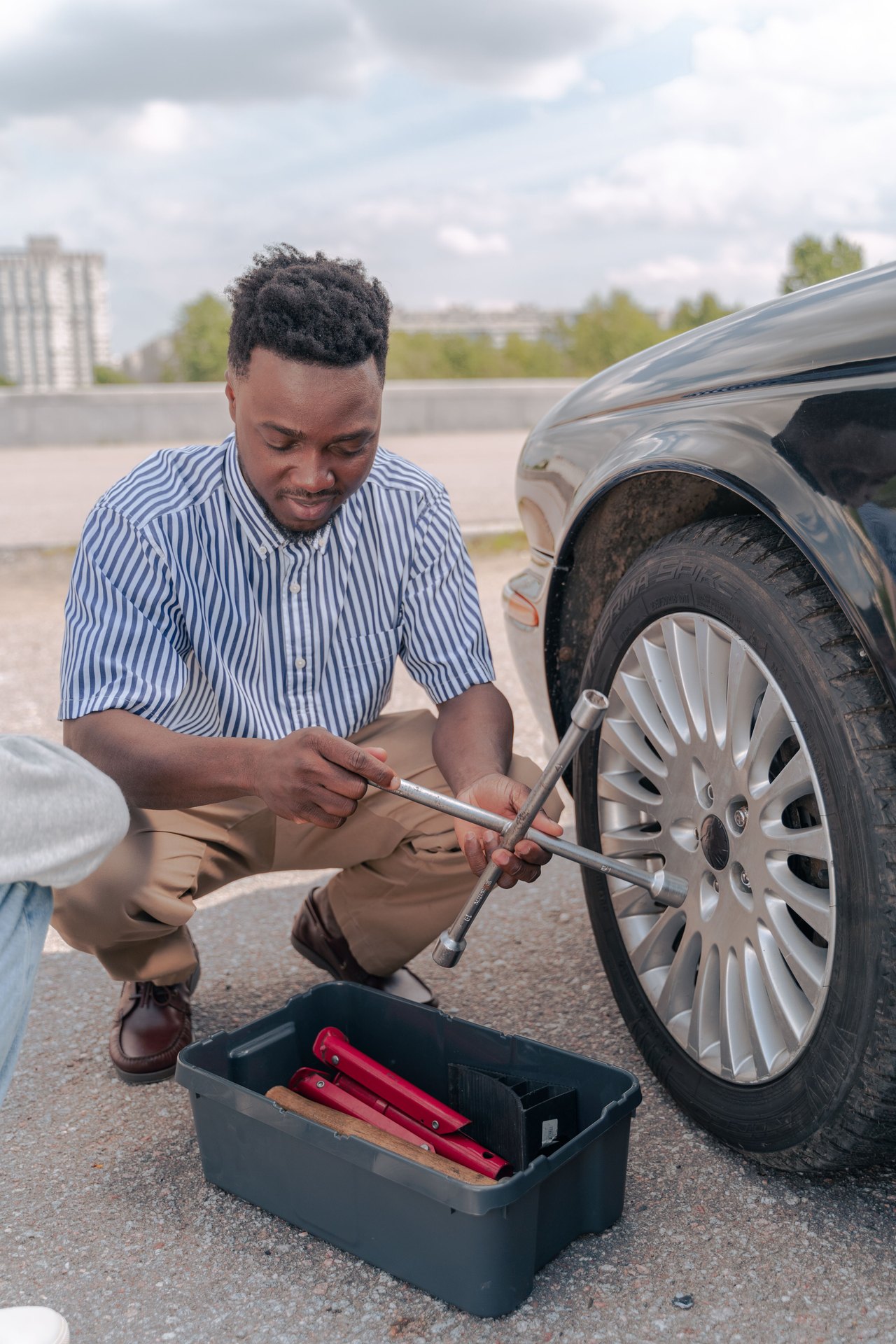
Most roadside tire changes fail on equipment rather than rubber. The jack is missing, the lug wrench does not fit, the wheel lock key left with the previous owner, or the lug nuts were run down by an impact gun at a shop and will not move by hand on a hot afternoon.
NHTSA's summer driving checklist covers the rest of the kit: a cell phone and charger, a first aid kit, a flashlight, flares and a white flag, jumper cables, a tire pressure gauge, a jack and a ground mat, work gloves and basic tools. Every item on that list earns its space for a roadside reason.
Where the car stops counts too. A soft shoulder on a county road will sink a jack, and a lane-side change on a highway puts a person in traffic for the length of the job. When the ground is wrong or the traffic is close, roadside assistance is the safer call than improvising.
Checking Your Spare Tire in Two Minutes
Do this once a month, cold, before the car has moved for the day.
- Find the spare and the tools that go with it: under the trunk floor, behind a side panel, or on a carrier beneath the bed.
- Put a gauge on the spare and compare the reading to the pressure printed on the tire or listed in the manual. Temporary spares are usually held at a far higher pressure than the road tires.
- Look at the tread and the sidewall. Replace at 2/32 of an inch, and note any cracking, cuts or bulges.
- Confirm the jack, the lug wrench and the wheel lock key are present, and that the wrench actually fits the lug nuts on the car.
- Read the speed and distance limits on the spare once, in daylight, so they are not news at ten at night.
Questions Hanford Drivers Ask
Three that come up on almost every flat tire call.
How often should I check the spare tire?
At least once a month, at the same time as the other four. NHTSA recommends checking the pressure of all tires, including the spare, at least once a month and when the tires are cold, meaning the car has not been driven for at least three hours.
Can I drive normally on a temporary spare?
No. A temporary spare carries speed and distance limits printed on the tire or listed in the owner's manual, set by the vehicle manufacturer. Treat it as a way to reach a tire shop, not as a replacement tire, and keep the trip short and slow.
What if the spare is flat too?
Then the car is not leaving on its own wheels. A mobile flat tire change can fit a usable tire at the roadside, and when there is nothing usable to fit, the vehicle needs a tow to a shop instead. Either way it is a phone call rather than a walk.