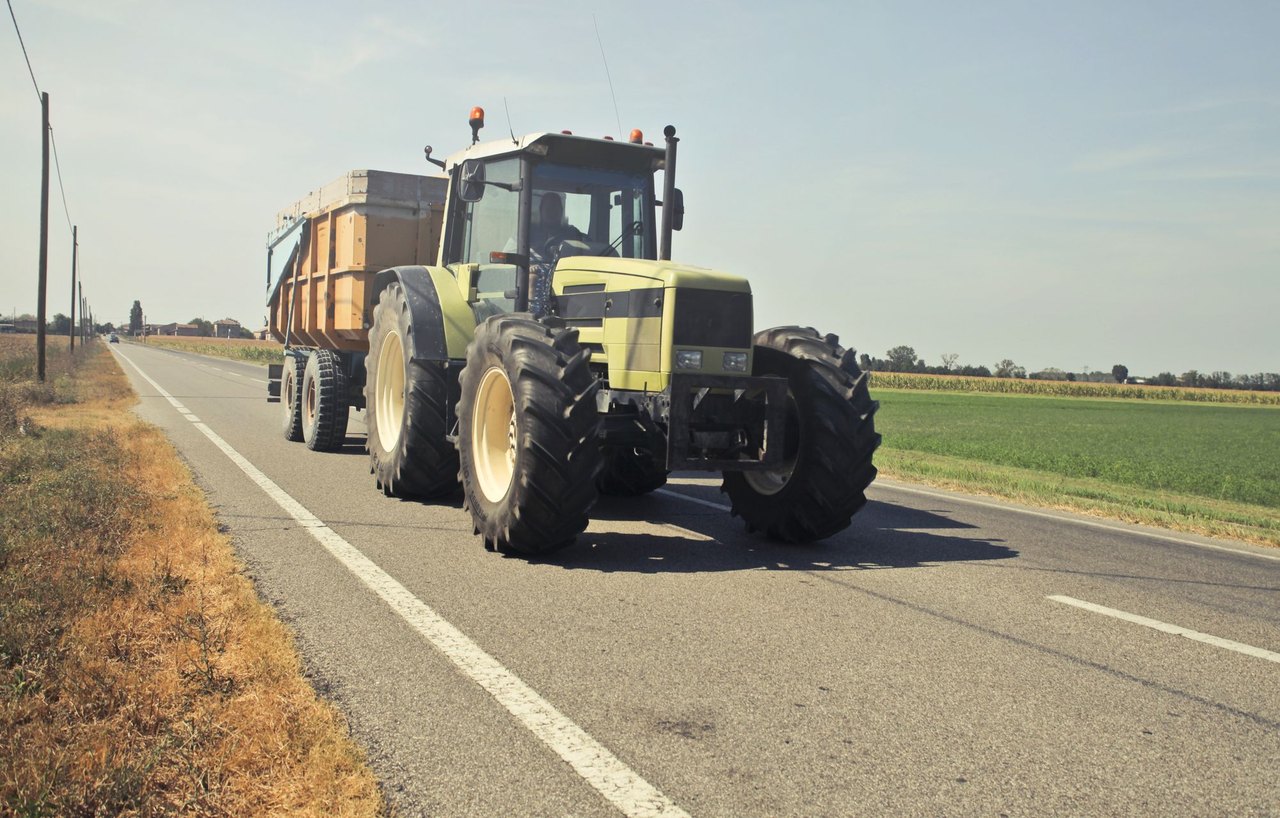
Meeting farm equipment on the road is routine around Hanford, and Kings County's crop figures explain why. The county produced $2.59 billion in agricultural value in 2022, ninth of California's 58 counties, and it sits between Tulare and Fresno, which rank first and second, according to the 2022 county report California's agricultural commissioners file with USDA. Almost every acre of that is reached by a two-lane road.
Machines do not stay in the fields. Tractors, harvesters, nut shakers, bin trailers and loaded flatbeds move between blocks on the same roads people use to reach Lemoore, Corcoran or Highway 198, and they travel at a fraction of the posted speed. Here is what California law allows when you come up behind one, why the gap closes faster than it looks, and what recovery involves when someone reads it wrong.
Harvest Season Puts Farm Equipment on Roads Built for Highway Speed
Farm equipment traffic peaks in the Valley from late summer through fall, when cotton, tomatoes, nuts and silage all move at once. That is the stretch where a driver is most likely to come over a rise on a county road and find a tractor moving at a third of the posted speed in front of them.
Equipment runs on a schedule that has nothing to do with the commute. A harvester heads out before first light and comes back after dark. A bin trailer loops between a field and a huller all day. On the roads around Armona, Stratford and the farm ground east of Corcoran, that traffic is heaviest exactly when the light is worst: low sun, dusk, and the early tule fog mornings that arrive once the nights turn cold.
Transportation incidents are the leading cause of death for farmers and farm workers, according to NIOSH, which puts the fatal injury rate across agriculture, forestry, fishing and hunting at 18.6 deaths per 100,000 full-time workers in 2022. The public road is the part of that picture shared with everybody else.
The Orange Triangle Means 25 mph or Less
The orange-and-red triangle on the back of a tractor is a speed warning. The California Driver Handbook describes it as marking slow-moving vehicles that usually travel at 25 mph or less, and its instruction to the rest of us is short: adjust your speed to share the road with these vehicles.
Twenty-five is a ceiling, not an average. An older tractor pulling a loaded implement often runs well under it, and the emblem tells you nothing about how wide the load is or whether the operator can see you.
Treat the triangle as a cue to come off the accelerator and read the road ahead, not as a signal to plan a pass. Where is the next field entrance, where does the shoulder soften, and is there a turnout coming.
The emblem also turns up on machines that are not tractors: self-propelled sprayers, forklifts crossing between yards, towed implements. If you can see the triangle, the vehicle ahead is not going to accelerate out of your way.
Closing Speed, Not Size, Is What Catches Drivers Out
The gap between a car and a piece of farm equipment closes much faster than drivers expect, because the speed difference is doing the work. At 55 mph behind a tractor moving 20, you are gaining 35 mph, which is a little over 51 feet every second. A gap that looked like several hundred feet when you crested a rise is gone in a handful of seconds.
This is why the handbook's three-second following rule needs thinking about out here. Three seconds behind a vehicle traveling at your speed is a cushion. Three seconds behind one traveling at a third of your speed is a decision you have already made. Scan far enough ahead to spot slow traffic before you are closing on it.
Dust compounds it. Equipment working a dry field throws a plume across the road that hides both the machine and whatever sits behind it. A harvester at dusk can be hard to separate from its own dust until braking is the only option left.
California's Passing Rules Decide Most of It for You
California's passing rules rule out most of the places a driver is tempted to pass farm equipment. The DMV handbook says not to pass while approaching a hill or curve where you cannot see whether traffic is coming, not within 100 feet of an intersection, bridge, tunnel or railroad crossing, and not at crossroads and driveways unless you have enough space to return to your lane.
On a Kings County farm road that removes almost everything. Field entrances, gates and packing-shed driveways are the crossroads out here, and there can be dozens in a mile.
The handbook also attaches a distance to the first rule: to pass safely, the hill or curve should be at least a third of a mile ahead. Oncoming traffic keeps covering ground during the eight or ten seconds you spend alongside a machine wider than the tractor pulling it.
The obligation runs in both directions. Under the same handbook, a driver moving slowly on a two-lane road where passing is unsafe must use a turnout area or lane to let others by once five or more vehicles have formed a line behind them. Most operators around here know it, and leaving them room to reach a turnout gets you past sooner than crowding does.
The Left Turn Into a Field Is the One That Surprises People
The collision drivers least expect is the one where the equipment ahead of them turns left. A tractor swings wide to the right before turning into a field entrance, which looks exactly like it is pulling over to let traffic pass, and a driver who reads it that way accelerates straight into the turn.
Two things make the move hard to read. Implements are wider than the tractor pulling them, so the operator needs the right shoulder simply to start the turn. Turn signals on older equipment are small, mounted low and easily lost in dust or low sun. Some carry none at all.
Do not pass a piece of farm equipment anywhere near a field entrance, gate or driveway. If it drifts right and you cannot see a marked turnout ahead, assume a left turn and stay put.
If You End Up Off the Pavement, Recovery Is Its Own Job
A near miss with farm equipment usually ends off the asphalt, and the ground beside a Kings County farm road is not a shoulder in the ordinary sense. It is soft, it falls away toward an irrigation ditch or a canal bank, and it will not hold a car that left the road at speed.
That changes what getting it out involves. A car sitting nose down a canal bank is a winch out and recovery job with a plan for where the truck can safely anchor, not something a borrowed strap fixes. If the vehicle is damaged, flatbed towing keeps the wheels off the ground so nothing bent gets dragged home. A loaded implement or an ag truck blocking a lane is a heavy duty towing call.
If anyone is hurt or the road is blocked, call 911 before anything else. Then move people to the field side of the vehicle, away from traffic, and wait there. Hanford Towing Service keeps 24/7 towing dispatch because harvest traffic does not keep office hours, and roadside assistance reaches a farm road at 4 a.m. as readily as at noon.
Common Questions About Farm Equipment on Kings County Roads
Is it legal to pass farm equipment on a two-lane road in California?
Yes, wherever the ordinary passing rules allow it. The restrictions are those that apply to passing anything: not while approaching a hill or curve where you cannot see oncoming traffic, not within 100 feet of an intersection, bridge, tunnel or railroad crossing, and not at crossroads or driveways unless there is room to return to your lane. On a farm road lined with field entrances, those conditions rule out most of the road.
What speed does the orange triangle on the back of a tractor mean?
It marks a slow-moving vehicle that usually travels at 25 mph or less, according to the California Driver Handbook. Plenty run slower than that under load. The emblem is a warning to approaching drivers, not a promise that the machine will speed up or pull aside.
Does farm equipment have to pull over to let traffic by?
On a two-lane road where passing is unsafe, a slow-moving driver must use a turnout area or lane once five or more vehicles have formed a line behind them. That does not mean it happens the moment you arrive: the operator still has to reach a turnout, and on some farm roads the next one is a mile away.
My car went off a farm road avoiding a tractor. Can it still be towed out?
Usually, though it is a recovery rather than a straight tow. Soft field edges, irrigation ditches and canal banks mean the truck needs an anchor point and room to work, and a damaged vehicle is better loaded onto a flatbed than dragged back up. How far off the pavement the car sits, whether a wheel is buried and how wet the ground is all change the approach, so describe the location and footing when you call.