The question comes up on almost every call: does my car need a flatbed, or is a wheel lift fine? Flatbed vs wheel lift towing is not really a question of which truck is better. They are different tools, and the right one depends on your drivetrain, your ground clearance, how far the vehicle is going, and how much room the driver has to work in.
What follows is what each truck actually does, how the two compare on the points that decide the call, and what to tell a dispatcher so the right one shows up the first time.
What is flatbed towing?
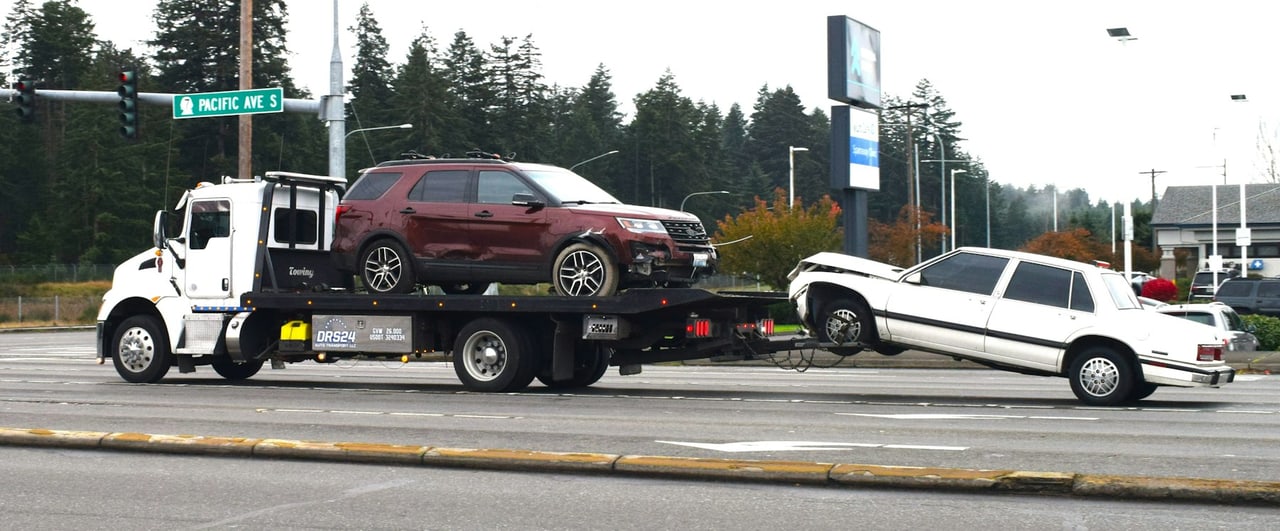
Flatbed towing carries your vehicle on a hydraulic deck instead of moving it on its own wheels. The bed tilts back to the ground, a winch pulls the vehicle up, and the deck levels off with all four tires resting on steel or aluminum rather than asphalt. In the trade these trucks are called carriers. Manufacturer specifications give a sense of the scale: Jerr-Dan lists light-duty carriers with roughly 19 to 21 foot decks and six-ton structural capacity, with heavier models running out to 30 foot decks.
The defining feature is that nothing on your car rotates during the trip. No wheels turning, no driveline spinning, no suspension loading unevenly over every expansion joint. That is why a flatbed is the default for anything valuable, unusual, or already damaged.
What is wheel lift towing?
Wheel lift towing raises one axle with a hydraulic yoke that cradles the tires, leaving the other two wheels rolling on the road. The yoke tucks under the tires rather than hooking the frame or bumper, which is what separates a modern wheel lift from the old sling trucks that chewed up bodywork.
These trucks are called wreckers. Jerr-Dan's light-duty wrecker range pairs booms in the 8,000 pound class with underlifts rated around 4,000 to 6,000 pounds, which covers the great majority of passenger cars and light trucks. The wrecker's real advantage is not capacity, it is reach. A wheel lift extends from a much shorter truck and can pull a car out of a space a carrier cannot even enter.
How do the two compare where it counts?
Five differences decide almost every call.
- Contact with the road. A flatbed keeps all four wheels off the ground. A wheel lift leaves two wheels rolling for the whole trip.
- Space needed. A wheel lift works in parking structures, alleys, tight driveways and packed lots. A carrier needs room to tilt its deck back and a clear run to winch the car up.
- Loading time. A wheel lift hooks up in a couple of minutes. A flatbed load takes longer, which matters when the vehicle is sitting in a live traffic lane.
- Distance. Two rotating wheels for eighty miles is meaningful wear, so a long haul pushes the decision toward a flatbed.
- Damage risk. For low, modified, heavy or already-wrecked vehicles, a flatbed removes most of the ways a tow can go wrong.
None of that makes one truck the winner. In a narrow alley behind the shops around Courthouse Square, the wheel lift that clears the space in four minutes is the better tool. On a run down Highway 198 with a lowered coupe, the flatbed that never lets the splitter touch anything is the better tool.
Which one does your vehicle need?
Start with the drivetrain, because that is the constraint you cannot negotiate around. Front-wheel-drive cars can usually travel short distances with the front wheels lifted and the rear rolling. Rear-wheel-drive cars go the other way around. All-wheel-drive and four-wheel-drive vehicles are the ones to be careful with: in many of them the drivetrain stays mechanically connected even with the engine off, so rolling two wheels turns components that are not being lubricated. For those, a carrier that lifts all four wheels is the straightforward answer, and the owner's manual will normally say so in as many words.
Ground clearance decides the rest. Lowered cars, cars with front splitters, classics with soft suspension, and electric vehicles with underbody battery packs all do better on a deck. So does anything that has been in a collision. If a wheel will not roll or an axle is bent, the choice has already been made for you. Our flatbed towing and wheel lift towing pages set out what each of our trucks handles.
What about motorcycles and heavy vehicles?
Motorcycles are their own category and never belong on a wheel lift. They ride on a deck, upright, secured with soft straps at the handlebars and the frame, which is why motorcycle towing is dispatched differently from car work.
At the other end of the scale, box trucks, RVs, farm equipment and loaded commercial vehicles exceed what light-duty equipment is rated to carry. Capacity ratings are not suggestions, and a truck working above them is a hazard to everyone around it. That work goes to heavy duty towing with the boom and underlift rating the weight actually calls for.
Who decides, and what should you tell dispatch?
In practice the dispatcher decides from what you tell them, and the driver confirms it on arrival. Four details get it right the first time: the year, make and model; whether it is front, rear or all-wheel drive; whether all four wheels still roll and steer; and what the pickup spot looks like, meaning a parking garage, a narrow alley, a soft county shoulder or an open lot.
One more thing worth knowing in California. Under Vehicle Code section 22513, it is a misdemeanor for a towing company or the operator of a tow truck to stop at the scene of an accident or near a disabled vehicle in order to solicit towing work. If a truck you did not call pulls up and offers to take your car away, you are under no obligation to accept, and the law is on your side. Call a company you chose.
Frequently asked questions
Four questions come up more than any others once drivers understand the difference between the two trucks.
Is a flatbed always the safer choice?
For the vehicle, essentially yes, because nothing on the car rotates or loads during the trip. For the situation, not always. If your car is stopped in a live lane, the faster hookup of a wheel lift can be the safer outcome overall, and the driver will make that call on the scene.
Does a flatbed cost more than a wheel lift?
Rates vary by company, distance and time of day, so ask for a quote when you call rather than assuming. What is consistent across the industry is that a carrier ties up a larger truck for longer, and pricing usually reflects that.
Can a flatbed get into a parking garage?
Usually not. Deck length and overall height put most carriers out of low-clearance structures, which is precisely the situation the wheel lift exists for.
My car is all-wheel drive. Can it ever go on a wheel lift?
Only with dollies under the wheels that would otherwise stay on the ground, or where the manufacturer's manual specifically permits it. Check the manual, and when there is any doubt, ask for the carrier.