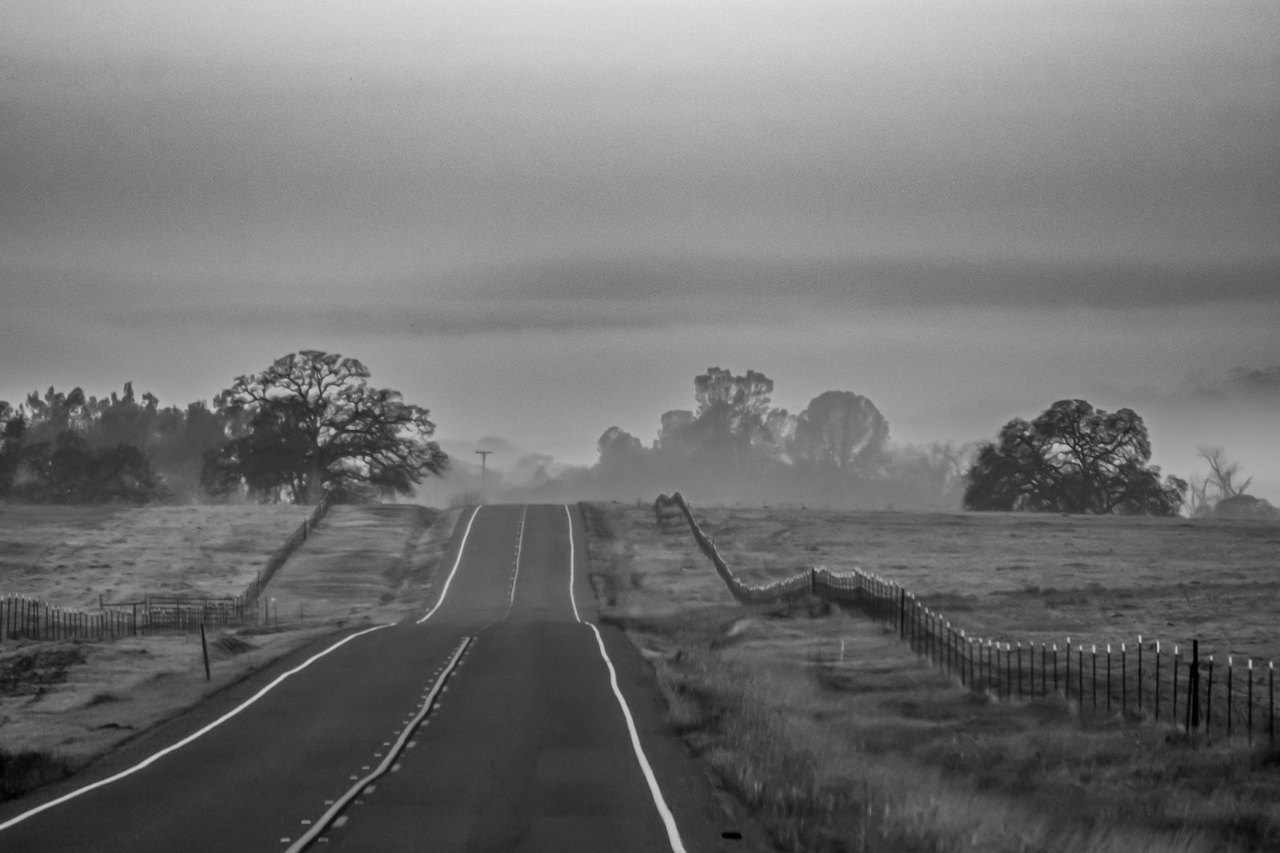
Tule fog is the one Kings County road hazard that can take visibility from a mile to a car length inside a quarter mile, and tule fog driving catches out people who have lived here their whole lives. It forms on still, damp nights after the valley's first real rains, pools in the low ground around Hanford, Armona and Lemoore, and it does not lift on a schedule.
This guide covers how valley fog actually behaves, what to change about the way you drive when you hit it, and what to do if you are the one already stopped on the shoulder with the hazards on.
Key Takeaways
- Tule fog is a ground-level winter fog that forms in place on the San Joaquin Valley floor; it does not roll in from the coast.
- Visibility can fall from clear to near zero inside a few hundred feet, most often between late evening and mid-morning.
- Low beams belong on in fog. High beams reflect off the water droplets and make seeing worse.
- The white edge line on your right is a better guide than the center line, because it keeps your eyes off oncoming headlights.
- Stopping on the shoulder in dense fog is one of the most dangerous things a driver can do, because following traffic cannot see you until it is close.
- The National Weather Service office that forecasts Kings County fog is based in Hanford and publishes an hourly Fog Severity Index.
- Caltrans answers a statewide highway conditions line at 1-800-427-7623.
Tule fog forms in the valley, not out at the coast
Tule fog is a ground-level radiation fog that forms in place over the valley floor on long, cold, windless nights after rain has soaked the ground. Heat left in the soil radiates away after sunset, the air just above the fields cools to its dew point, and the moisture condenses where it sits. That mechanism explains the two things drivers notice most: it appears without warning on an evening that looked clear, and it is thickest in the low, damp ground between fields.
Because it forms locally, tule fog is patchy in a way coastal fog is not. A stretch of Highway 43 can run clear for two miles and then drop to a few car lengths where the road dips past an irrigated field. The National Weather Service notes that fog contributes to numerous travel accidents every year, and that patchiness is much of the reason. The danger sits in the transition, not in the fog you can already see.
The office that forecasts your fog is right here in Hanford
The National Weather Service forecast office for the San Joaquin Valley is in Hanford, on Foggy Bottom Road. That office publishes an experimental Fog Severity Index that maps expected fog severity across the valley in hourly panels running out roughly fourteen hours ahead.
For a driver deciding whether to leave at five in the morning, that is a genuinely useful planning tool, and it costs nothing. If the panels put a severe band over Kings County at sunrise, that is the morning to leave earlier or move the trip. Pair it with Caltrans road information, which also takes calls at 1-800-427-7623 for current highway conditions.
Low beams, lower speed, and the white line on your right
Three changes matter most in fog: your headlights, your speed, and where you point your eyes. Switch to low beams. High beams throw light into the droplets suspended right in front of the car and bounce it straight back, which lights up the wall of fog instead of the road beyond it. Fog lights, if the vehicle has them, sit low and aim under the worst of it.
Slow to a speed where you could stop inside the distance you can actually see. That is usually far below the posted limit, and it is the part drivers resist. Use the white edge line on your right to steer by rather than the center line, so oncoming headlights are not pulling your eyes across the road.
Turn the radio down and crack a window. On these county roads you will often hear a tractor pulling out of a field, or a slow-moving truck, well before you see it.
Stopping on the shoulder is the riskiest thing you can do in dense fog
If you can keep moving safely, keep moving until you reach somewhere fully off the roadway. A vehicle parked on a Kings County shoulder in dense fog is invisible to following traffic until they are almost on top of it, and drivers instinctively steer toward whatever tail lights they can finally see. That instinct is what turns one stopped car into several.
When you have no choice, get as far off the pavement as the shoulder allows, put the hazards on, and get out on the side away from traffic. Then move away from the vehicle, behind a fence line or well back from the asphalt, and make your calls from there. Standing beside the car means standing in the impact zone.
Once you are stopped, being seen matters more than being quick
When the vehicle will not move, your job is to be visible and to be somewhere safe, not to fix anything. Hazards on, interior light on if it is dark, everyone out and well clear of the roadway before the calls start. If you carry flares or reflective triangles, set them further back up the road than feels necessary, because fog steals the reaction time a driver would normally have.
Then give the dispatcher something precise. On the county roads around Hanford, the nearest cross street or a mile marker beats a street address, and a dropped pin from your phone beats both. Say plainly whether the vehicle is sitting where traffic is still moving, because that changes how the truck is routed and what lighting it brings. Our emergency towing and roadside assistance crews work through fog season every year, and knowing exactly where you are sitting is most of the job.
Check the fog before you leave, not after you are in it
Fog decisions are easy at the kitchen table and hard at fifty miles an hour. Before an early start between November and February, look at the Fog Severity Index panels, check the Caltrans conditions, and decide then whether the trip is worth making.
The rest is preparation you only do once. Clean the windshield inside as well as out, because film on the inside of the glass scatters light badly in fog. Replace wipers that smear instead of clear. Confirm that every tail light and hazard works, since in fog those lamps are the only thing between you and the car behind you. And keep a charged phone and a warm layer in the vehicle, because a fog-season wait on a valley road is a cold one. If the car is already down and the visibility is poor, our 24/7 towing service answers through the night.