Federal summer driving guidance is blunt about why engines let go in hot weather: high summer temperatures accelerate the rate at which rubber belts and hoses degrade, so a cooling system that was adequate in March can fail in July. Knowing what to do when your car overheats matters most on the open stretches of Highway 198 and Highway 43, where there is no shade and the next exit is a long way off.
The steps below run in order. Follow them and you protect the engine. Skip to the middle and you risk turning a split hose into a cracked head.
Step 1: Air conditioning off, heater on full
The first move costs nothing and buys real time. Switching the air conditioning off takes a significant load off the engine immediately. Then turn the heater to maximum with the fan on high, because the heater core is effectively a second radiator, and running it pulls heat out of the coolant and dumps it into the cabin.
On a triple-digit valley afternoon this is genuinely unpleasant, and it is still the right call. It is often the difference between reaching an exit and stopping where you are. Put the windows down and keep going only as far as the next safe place to pull off.
Step 2: Get off the road before the gauge pegs
Do not wait for the needle to reach the red or for steam to show. The moment the temperature gauge climbs past its usual position or a warning light appears, start looking for somewhere fully off the pavement. A driveway, a farm turnout, a station apron or a wide gravel shoulder all beat a narrow strip beside moving traffic.
If you are in stop-and-go traffic, moving beats idling, because airflow through the radiator is what the cooling system depends on. If you are stuck and cannot move at all, shifting to neutral and briefly raising the engine speed helps the water pump and the fan move more coolant and more air.
Step 3: Shut it down and leave the hood closed
Once you are stopped safely, switch the engine off and leave the hood shut for the first several minutes at least. A hot cooling system is pressurised, and opening a radiator cap or coolant reservoir while it is hot can vent scalding coolant and steam straight up at you. This is the step where most overheating injuries happen.
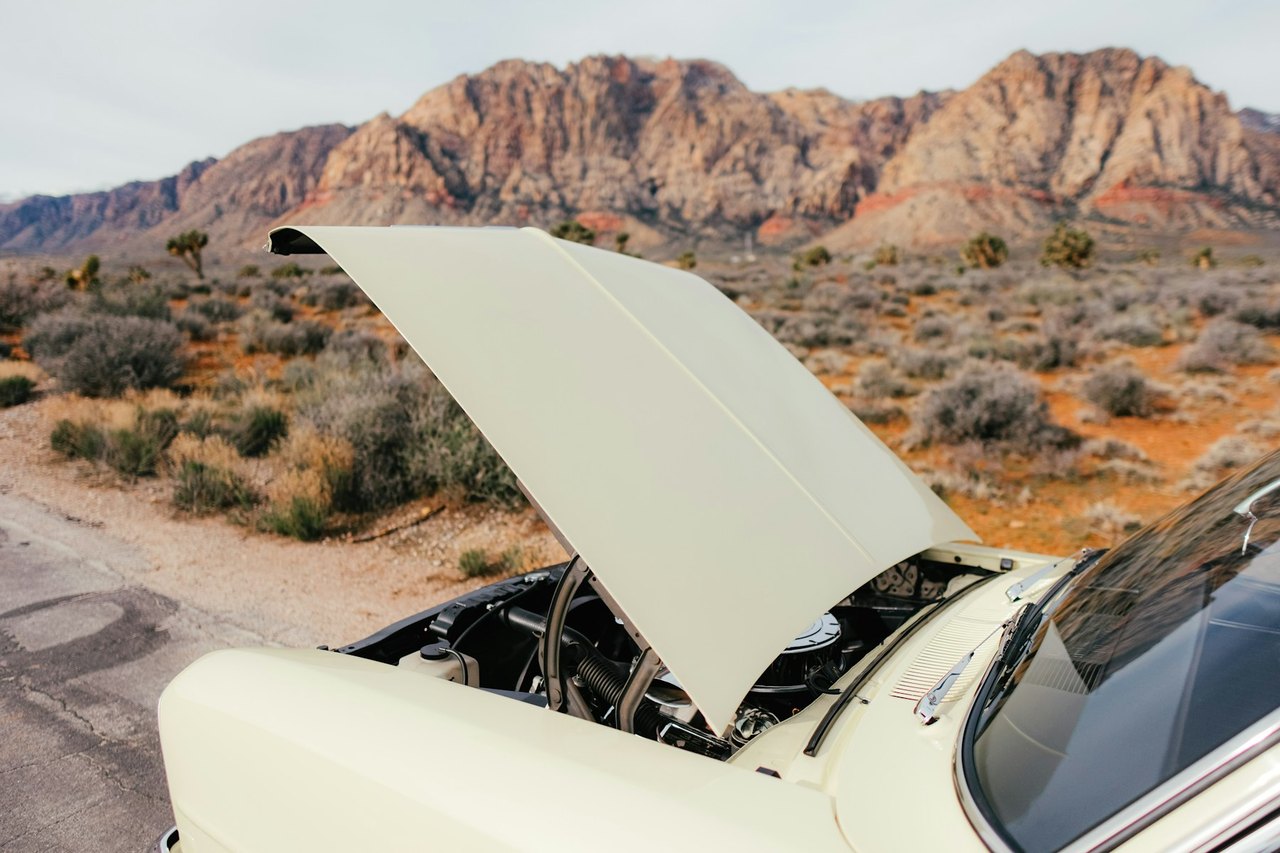
When the engine has been off long enough to feel warm rather than hot, open the hood and let the heat escape. Twenty to thirty minutes is a realistic minimum on a hot day, and longer is better.
Step 4: Get yourself out of the heat, not just the car
A stopped car in valley heat turns into an oven quickly. The National Weather Service office that issues Kings County forecasts sits here in Hanford, and NWS heat guidance warns that temperatures inside a parked vehicle rise to dangerous levels even on mild days, with a dark dashboard reaching 180 degrees or more. If there is shade within reach, use it. If there is not, stay out of the direct sun however you can.
Drink the water you have, and do it before you feel thirsty, which is what the same NWS guidance advises. If anyone with you is a young child, is older, or has a condition that heat affects, getting them somewhere cool outranks anything to do with the car.
Step 5: Check the coolant only once the engine is cold
When everything is cool to the touch, look at the coolant reservoir. If the level sits below the minimum mark and you are carrying coolant or water, topping it up may be enough to reach a shop. NHTSA's summer driving guidance is to make sure the vehicle has enough coolant and that it meets the manufacturer's specification, and to have the system checked for leaks if the level keeps dropping.
Look underneath while you are down there. A puddle of brightly coloured fluid, a split hose, or a shredded belt tells you this is not a top-up situation. So does a reservoir that is full while the engine still ran hot, which usually points at a thermostat, water pump or cooling fan that has failed.
Step 6: Know when it stops being a roadside fix
Call for a tow instead of restarting if any of these are true: the level drops again within minutes of topping up, there is a visible leak, steam or white smoke came from under the hood, the warning returns as soon as you drive, or the engine made any knocking or grinding noise while it was hot. Each of those means running the engine further risks damage that costs many times what the tow does.
The federal summer safety advisory recommends carrying a roadside kit with a charged phone, drinking water and a flashlight, precisely because well-maintained vehicles still break down. When it comes to that, our roadside assistance and emergency towing crews cover Hanford and the rest of Kings County, and our 24/7 dispatch line answers at any hour.
Frequently asked questions
Four questions come up on nearly every overheating call we take through the summer.
Can I pour cold water into a hot engine?
No. Cold water hitting hot metal causes rapid contraction that can crack a cylinder head or an engine block. Wait until the engine is genuinely cool, then add fluid slowly.
Is it safe to keep driving if the gauge drops back down?
Only as far as a shop. A gauge that recovers usually means airflow improved or the thermostat finally opened, not that the underlying fault has gone away. Drive it to help, not home and back.
How far can I drive an overheating car?
Treat the answer as zero. Engines are damaged by heat in minutes rather than miles, and the damage is often not obvious until much later.
Why is summer so much worse than the rest of the year?
Heat attacks the parts of the cooling system that were already ageing. NHTSA notes that summer temperatures accelerate rubber degradation in belts and hoses, so components that held up all winter give way in the first genuinely hot week.