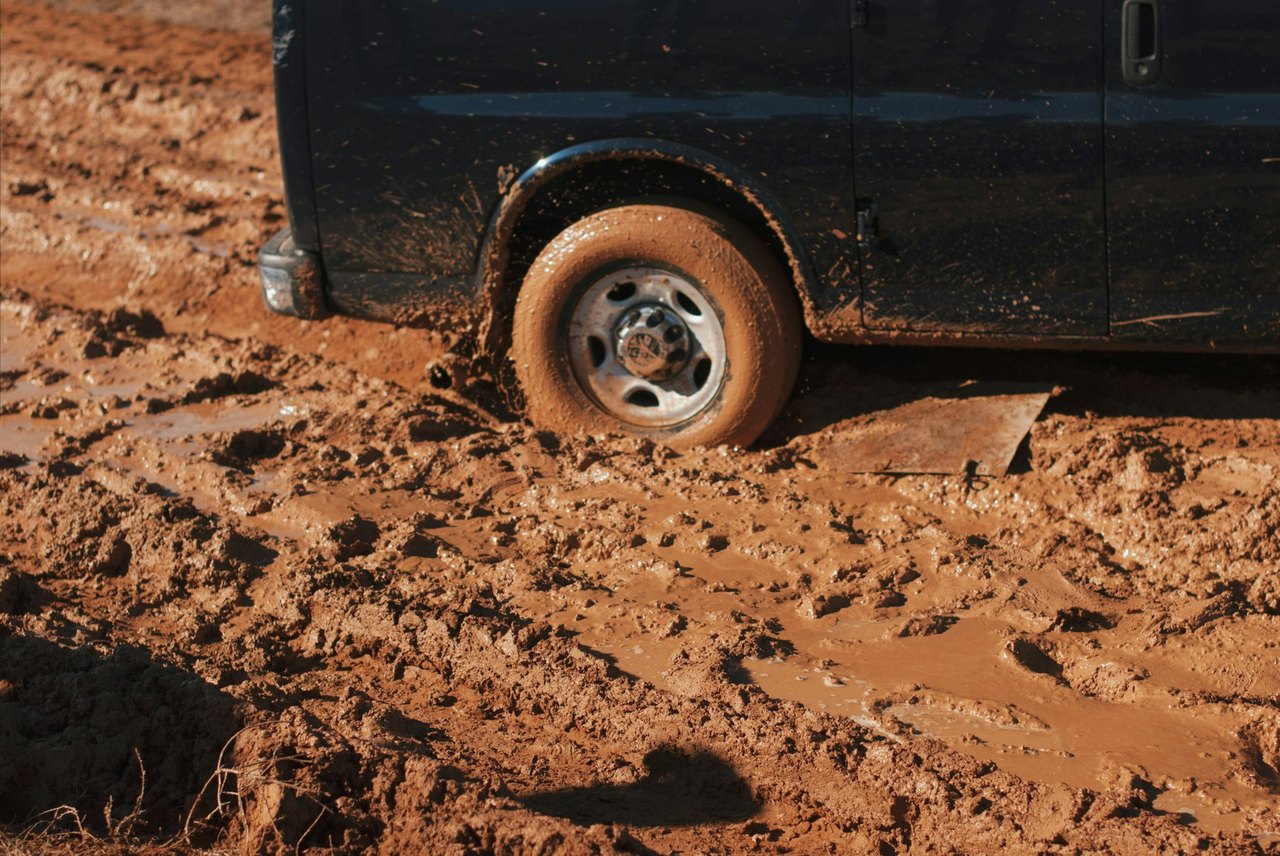
A vehicle stuck in mud is a winter and spring staple around Hanford, and the geography explains most of it. Kings County is flat, heavily farmed, and threaded with dirt turnouts, irrigation ditches and shoulders that look solid and are not. Add one wet week and a shoulder that held a truck in August will take a wheel past the rim in February.
Below are the five ways vehicles actually end up stuck out here, what each takes to undo, and why a winch-out is a rigging job with genuine injury risk rather than a favour to ask of whoever happens to be passing.
Key Takeaways
- Most stuck calls in farm country come from soft shoulders and dirt turnouts, not from anyone going off-roading.
- Spinning the wheels digs the vehicle deeper; the first thirty seconds decide how hard the recovery will be.
- A winch-out is a rigging job under heavy load. Warn's own guidance is that every winching situation has the potential for personal injury.
- Straps, ropes and shackles that fail under load become projectiles, which is what catches bystanders rather than the driver.
- Irrigation canals are not somewhere to climb down. The Bureau of Reclamation warns the water is cold and swift and the walls are steep and slippery.
- Never put yourself under, behind, or in line with a vehicle that is on a slope or under tension.
- Give the dispatcher the nearest cross street or a dropped pin, because farm roads are close to impossible to describe.
1. The soft shoulder that gives way
The most common stuck in the county is a driver who pulled a little too far off a two-lane road. The asphalt edge drops an inch or two onto graded dirt, the outside wheels take the weight of the vehicle on ground that has been soaking for a week, and the car settles.
What makes this one deceptive is that it usually looks trivial. One wheel is barely off the pavement. But that wheel has no traction at all, so the differential sends everything to it, and thirty seconds of throttle turns a two-inch drop into a buried hub.
2. The dirt turnout after a wet week
Farm turnouts and field entrances drain badly by design, because they are built for tractors rather than for passenger cars. Water sits on them, the surface skins over and looks dry, and underneath there is a foot of saturated clay.
This is the classic delivery-driver and field-visit stuck. The vehicle goes in fine under its own momentum and cannot climb back out, because getting out means starting from a standstill on the worst ground of the whole approach.
3. Sliding down a ditch or canal bank
This is the one to take seriously, because the vehicle is no longer the main hazard. Kings County farmland is laced with irrigation ditches and canals, and a vehicle that slides down a bank ends up nose-down on a steep, slick surface with water at the bottom.
Do not climb down after it, and do not send anyone else down either. The Bureau of Reclamation is blunt about why: canal water can be cold and swift, and steep, slippery canal walls make it very difficult to climb back out once a person or an animal has entered. Get everyone up on level ground, stay there, and call it in. If anyone is in the water, that is a 911 call before it is a tow call.
4. Sand, gravel and the freshly graded road
Fresh grading leaves a deep, loose layer that behaves like dry sand, and it strands two-wheel-drive vehicles that would have been fine on the same road a month later once traffic had packed it down.
The tell is that the vehicle sinks evenly rather than tipping. Traction is simply gone in all directions. Rocking it back and forth sometimes works in the first few seconds and is counterproductive after that, because each cycle builds a deeper trough with a wall at each end.
5. High-centred on a berm or a rut
High-centring is when the frame or the underbody is resting on ground while the wheels hang with little weight on them. It happens crossing a berm at an angle, or straddling a rut that deepens partway along.
This one cannot be driven out of at all, whatever the drivetrain, because the tyres are barely loaded. It also carries the highest risk of expensive damage, since whatever is taking the weight underneath is usually an exhaust, a fuel line, a differential housing or a battery pack. Recovery normally means lifting rather than simply pulling.
What a winch-out actually involves
A winch-out is controlled rigging, not brute force. The operator needs an anchor that will hold, a pull line angled so the vehicle comes out the way it went in, and a plan for what happens if something lets go. Warn's Basic Guide to Winching covers safety precautions, rigging techniques and hand signals precisely because, in its own words, every winching situation has the potential for personal injury.
That is the argument against the tow strap in someone's truck bed. Recovery straps and shackles store an enormous amount of energy under load, and when one fails it does not fall to the ground, it travels. Damage to bumpers, tow eyes and frames from improvised pulls is common and rarely covered by anything.
Our winch out and recovery trucks carry rated equipment and the operators are the ones standing in the risk zone rather than you. For anything over light-duty weight, a loaded truck or farm equipment, the work goes to heavy duty towing with the boom rating the job calls for.
What to do while you wait
Stop trying to drive out the moment you realise you are stuck. Every extra second of wheelspin makes the recovery harder, longer and more expensive, and on clay it can bury a vehicle to the floor pan.
Get everyone out and onto firm, level ground, well away from the vehicle and well away from any ditch. Put the hazards on. If you are on or near a road, stand back from the travel lane, because a car halfway off the shoulder is exactly the hazard drivers do not expect, especially in the fog season we wrote about in our guide to driving in tule fog.
Then work out where you are. The nearest cross street, a canal name, a field number or a dropped pin from your phone will get a truck to you far faster than a description. If the vehicle is blocking a lane, say so, because that changes how quickly emergency towing is dispatched.