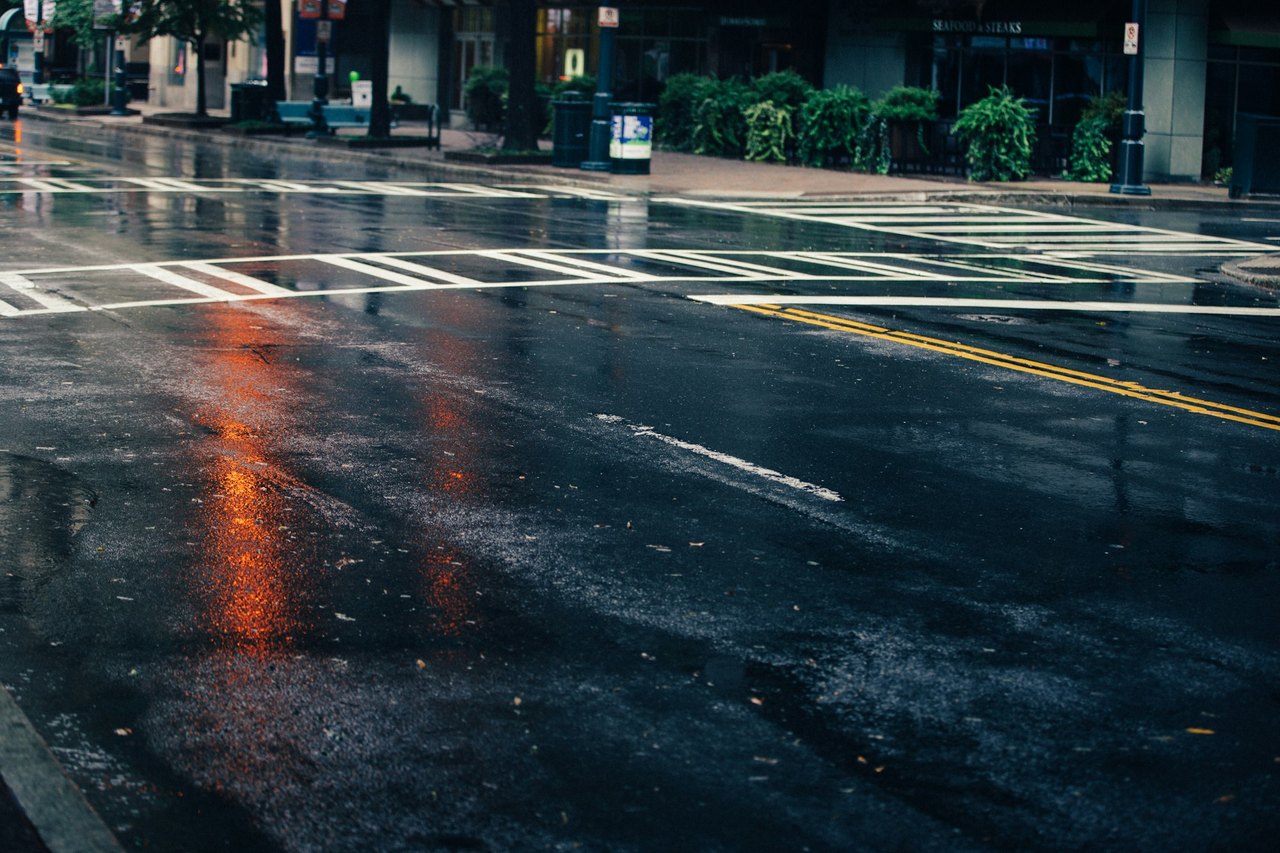
A drizzle in October is more dangerous than a downpour in January, and the reason is already on the pavement. Five months without rain leave a film of oil and road grime across Kings County, and the first light rain does not wash it away. It floats it. The California Driver's Handbook says to slow down at the first sign of rain, drizzle or snow, "especially true if it has been dry and hot for some time, because oil and dust on the road's surface have not been washed away."
By the time the season's first storm reaches Highway 198, the asphalt has had a whole Valley summer to collect what a wet road then lifts. What follows is a sequence for that storm: what to settle before you leave, the one thing on the car that decides whether you stop in time, and what to do if the road wins anyway.
Step One: Treat the First Hour of the Storm as the Worst of It
The most slippery driving of a storm usually happens in its first hour, not during its heaviest rain. Light rain lifts months of oil and grime off the surface without being heavy enough to flush it away, so the pavement spends that hour under a thin, mobile film. Once rain has fallen steadily the film is gone and grip improves, which is why a soaked road at hour three is often safer than a barely damp one at minute ten.
The change you make is speed, and the handbook is specific: on a wet road, reduce your speed by 5 to 10 mph. It is not a dramatic number, and it buys back the stopping distance the film takes away. Add space in front of you too, because every car ahead is on the same compromised surface and may not know it yet.
Around Hanford that matters most on the stretches nobody files as hazardous. Lacey Boulevard, 12th Avenue and the county routes toward Armona do not look slippery, and a drizzle that barely justifies the wipers is enough.
Step Two: Decide Before You Leave Whether the Trip Can Wait an Hour
If a trip can wait until the road has had an hour of steady rain on it, waiting is the cheapest safety measure available. That is a real decision, worth making on the season's first wet morning rather than by default.
Rain is not a minor category of crash. The Federal Highway Administration counts nearly 745,000 weather-related vehicle crashes in an average year, roughly 12 percent of all crashes, and reports that over 77 percent of them happen during rain or mist. The same agency puts the annual toll at over 3,800 people killed and over 268,000 injured in weather-related crashes.
So split the trip list. An errand, a parts run, a drive to Lemoore with no clock attached: give it an hour. A shift start is different, and there the move is to leave earlier rather than drive faster, because the time you are protecting is exactly what wet pavement takes. If it goes wrong at six in the morning on Highway 43, round-the-clock dispatch is the fallback, not the plan.
Step Three: Check the One Thing That Decides Whether You Stop in Time
Tread depth, not driving technique, decides how much water your tires can move before the rubber reaches the road. The National Highway Traffic Safety Administration is direct about what tread is for: it "provides the gripping action and traction that prevents your car or truck from slipping and sliding, especially when the road is icy or wet." The traction grade molded into a sidewall is "an indication of a tire's ability to stop on wet pavement."
NHTSA's replacement threshold is 2/32 of an inch, and two checks need no gauge. Every modern tire carries tread wear indicators; when the tread is level with those bars, the tire is finished. Or put a penny in the tread with Lincoln's head upside down: if you can see the top of his head, replace the tires.
Pressure matters the same morning. NHTSA recommends checking every tire, including the spare, at least monthly, measured cold rather than after a drive. A Valley summer of triple-digit afternoons is hard on rubber, and the first cool mornings drop pressure just when you need the contact patch. Sorting that in the driveway beats a roadside tire change on a wet shoulder, and our guide to checking your spare tire covers the one nobody looks at.
Step Four: Turn the Headlights On the Moment the Wipers Do
In California the headlights stop being a judgment call once the wipers are running. The California Highway Patrol states it without qualification: "California law requires headlights to be on when wipers are used." Daytime running lights are not the same thing, because on most vehicles they leave the tail lights dark, and the car you most need to be seen by is the one behind you.
The CHP's other wet-weather guidance is the same short list every time: reduce speed, increase following distance, and understand that rain-slicked roads cut traction and raise the risk of hydroplaning. The handbook attaches a number to the visibility half of that. If you cannot see farther than 100 feet, it is not safe to drive faster than 30 mph.
Valley drivers file that rule under fog season, which arrives later and gets the attention. Rain earns it first. A heavy band crossing open ground between Hanford and Corcoran cuts visibility as fast as anything that forms overnight, and the response is the one our guide to driving in tule fog around Hanford describes: slow to a speed that matches what you can see.
Step Five: Know What Hydroplaning Feels Like Before It Happens
Hydroplaning, in the handbook's words, "is a vehicle riding on water because the tires lose all contact with the road." The steering goes light and small inputs stop doing anything. What happens next is the part to remember: "A slight change of direction, applying the brakes, or a gust of wind could throw the vehicle into a skid."
That is why standing on the brake is the wrong reflex. The handbook says not to use the brakes, because sudden braking may cause you to lose control. Ease off the accelerator, hold the wheel still, and let speed bleed off until the tires find the surface. The list of ways to avoid getting there is short:
- Drive slowly.
- Steer around standing water where you safely can.
- Slow down if you hear sloshing sounds from the tires.
- Slow down when changing lanes or direction.
The third earns its place here: the Valley floor is flat and water does not run off the way it does on a graded hillside. It stands at the pavement edge, in the ruts of older county roads, and where a farm crossing meets the road. On Highway 43 and the routes toward Laton, the deepest water sits in the few feet nearest the shoulder, which is exactly where a driver drifts when a truck comes the other way.
Step Six: After a Slide, Decide Whether the Car Gets Driven or Carried
A car that has slid off a wet road is not automatically drivable, even when it restarts and the body looks straight. Low-speed slides put their damage where nobody looks: the inner sidewall of a tire that caught a curb edge, a tie rod bent just enough to throw the alignment, an oil pan that found a rock.
Three checks settle it. Look at the inside face of every tire that touched something. Hold the wheel straight and see whether the front tires point where it says they do. Then move at walking pace and feel for a pull, a vibration or anything dragging. Any one of those means the car gets carried, not driven: a flatbed in Hanford when the steering or drivetrain is in question, a wheel lift for simpler cases in tighter spots.
If the wheels have left the pavement and the car is in a ditch or on a canal bank, that is a winch-out and recovery job rather than a push. Wait well clear of the travel lane with the hazard lights on, because traffic going past is on the same slick road you just lost and a car on a wet shoulder is the hardest thing to see. If it is blocking a lane, emergency towing is the call.
Drive the First Storm Like You Have Not Driven in Rain Since April
Because you probably have not. The habit worth building runs against instinct: the opening of the wet season deserves more caution than the middle of it, and the morning the forecast says "a few showers" deserves more than the one it says "heavy rain." Drivers brace for the storm that looks serious and get caught by the one that does not.
The rest is a five-minute job. Take a penny to the driveway, check all four tires and the spare, and read the pressures cold. Doing that in October is worth more than doing it in January after something has already gone wrong.
If a storm does put a vehicle off the pavement, winch-out and recovery gets it back without adding damage, and Hanford Towing Service runs emergency towing across Kings County when a car cannot be left where it stopped.